
The First Wildcatter
Michael Benedum, Pittsburgh’s Oil Shadow, and the Return of Frontier Economics

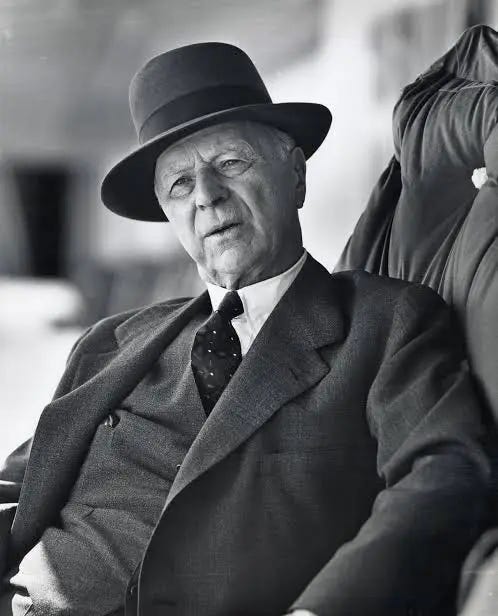
John D. Archbold—Standard Oil’s operator-in-chief and John D. Rockefeller’s right hand man—once heard talk of promising oil in Oklahoma and scoffed like the idea offended physics.
“Are you crazy” he said. “Why, I’ll drink every gallon of oil produced west of the Mississippi.”
That’s how mistakes are made at the top.
They mistake today’s center of gravity for permanence—and they say things like “Are you crazy?” right before the world moves under their feet.
Somewhere in that same American moment, a man was already building a life around the opposite instinct: the belief that the frontier is never gone, only relocated. That the crowd’s confidence is often the signal, not the truth.
His name was Michael Late Benedum—a West Virginian by birth, a Pittsburgh operator by choice, and in the lore of the industry, the “king of the wildcatters.”
A few people today remember the outcomes: the oil finds, the fortune, the name on buildings.
But the useful story isn’t the trophy case.
The useful story is how he operated—how he built a machine that could survive misses long enough to catch the strikes. And why that temperament—dismissed during the era of globalized smoothness—is becoming relevant again.
Pittsburgh’s hidden oil stack
Let us start with some history. Pittsburgh is steel in the public mind. It earned that brand honestly.
But the deeper Rust Belt truth is that Pittsburgh was never “one industry.” It was a capability stack—a place that could turn raw material into systems. Steel was the loud story. Oil was the quieter one: finance, refining, transport, and deal-making humming alongside the furnaces.
If you want to understand why a Pittsburgh oilman matters, we should start with the line most people forget: Pennsylvania made the oil age first. Before Texas became an icon, before Venezuela became a cautionary tale, western Pennsylvania—Titusville and its neighbors—was the ignition point of a new civilization.
And Pittsburgh money—especially Mellon money—helped extend that civilization outward. Pittsburgh capital backed pipeline, refining, and production ventures that pushed the Pennsylvania model into Ohio, West Virginia, and beyond. Pittsburgh didn’t merely watch the oil century begin. It helped underwrite it.
That line doesn’t just flatter local pride. It explains a pattern:
Pittsburgh didn’t merely build things.
Pittsburgh built builders—people comfortable with physical reality, with risk, with the ugly middle layers between discovery and wealth.
Benedum was one of the purest examples.
The stack of singles
Benedum’s early genius wasn’t geology. It was human nature.
In his Benedum biography “The Great Wildcatter,” author Sam Mallison describes a fateful train ride from Clarksburg to Parkersburg in the summer of 1890 that set Benedum along the path to becoming one of the nation’s richest oilmen.
Benedum offered his seat to an older, mustachioed stranger. The stranger returned the kindness by asking the 20-year-old Benedum if he would like to learn more about his line of work, Mallison wrote.
“What is it?” asked Benedum.
Within no time at all, Benedum was working for that man: John Worthington, General Superintendent of the South Penn Oil Company.
Seeing promise in Benedum, Worthington sent him out to lease difficult land with a light budget. On the list was a key holdout—what the landmen called a “king bee”—the influential farmer who could hold the whole neighborhood in place.
Benedum didn’t argue the assignment was too difficult.
He simply went to the bank and converted his large bills into a thick stack of one-dollar bills.
Not because he needed ones.
Because he understood what every salesman eventually learns: numbers don’t persuade—vision does. A solution does. The feeling of being understood so well you can hold it in the palm of your hand.
He visited the king bee and invited the farmer’s wife to join the conversation. The oil talk started. His offer grew. The wife watched the stack grow and saw what it could do to a household.
The farmer signed.
Then Benedum made the move that reveals his true genius: he hired the king bee to accompany him to visit neighbors—turning the holdout into a credibility engine. He leased the entire list for a fraction of the light budget Worthington allocated.
That’s the first rule of the wildcatter:
The resource isn’t the barrel.
The resource is the deal and story wrapped around it.
26 Broadway and Rockefeller’s chokepoint
Benedum knew finding oil is hard. He also knew the real fight starts after you find it.
Because the commodity is only half the story. The other half is who controls the other layers—transport, refining, customers, prices, access. The people who control those layers can squeeze you even if they didn’t drill a single inch.
In that age, Rockefeller’s Standard Oil was that machine.
Benedum and Joe Trees—his technical counterpart and operating partner—built their fortune on “hits and misses,” and then ran into the Standard Oil system. Standard offered a price that felt like a chokehold, buying low and reselling high.
Benedum’s response wasn’t to complain.
It was to build leverage.
He threatened to build his own refinery. He sold oil directly to Standard’s customers. He created enough pain that Standard summoned him to headquarters at 26 Broadway.
What happened next is one of the cleanest stories in Wildcatter history.
Standard opened with $2 million. Benedum stood up: “Come on, boys. Let’s go back to Pittsburgh.” He tried to leave. The offer rose. He tried to leave again. It rose again.
Then Benedum insisted: principal-to-principal. He wanted the real decision maker, John D. Archbold, not lieutenants.
The deal closed at $6 million, and Benedum retained the gas rights—then an afterthought to most operators, but optional future value that would sustain the enterprise long after the sale.
This is the second rule of the wildcatter:
Don’t just win the price. Win with leverage.
The crank in formalwear
In 1905, Benedum and Trees went to Illinois—a place not then credited as a serious oil producer. His mentor even warned him off.
Then a bizarre-looking stranger in formalwear claimed the oil trend ran opposite what experts believed. Locals dismissed him as a crank. The consensus was comfortable.
Benedum listened anyway.
They leased huge acreage cheap. The first well was modest. The second was enormous. Illinois vaulted into national production. On a chart, it looks obvious. On the ground, it looked like listening to a crank.
That’s the third rule:
Consensus is often strongest right before it breaks.
And that rule is not confined to oilfields. It governs cities, industries, and nations.
“No oil west of the Pecos”
Every industry has commandments—rules repeated until they harden into religion.
One commandment in Texas said there was no oil west of the Pecos. It was considered a long shot.
Benedum drilled anyway.
And the Yates field came in, becoming one of those strikes that doesn’t just pay—it rewrites the map of what’s possible, and humiliates everyone who turned yesterday’s pattern into law.
On October 28, 1926, the Yates #1 came in at 4,000 barrels a day. By 1929, the field was producing at a “Golcondic rate” of 204,000 barrels a day, making it one of the richest concentrated fields in U.S. history.
This is the fourth rule:
The frontier exists wherever someone still believes this proverb—“no oil west of the Pecos,”
The global wildcatter
If Benedum’s story ended in the U.S., it would still be a legend.
But the wildcatter mind doesn’t stop at state lines. It follows the idea of opportunity until it hits a wall.
By mid-career, Benedum was opening fields in Illinois, Louisiana, Texas, Canada, Mexico, and overseas, often in jurisdictions where the real work was not just drilling but navigating new laws, partners, and regimes. He operated a worldwide business from Pittsburgh, using the city as a control room for far-flung frontier bets.
At that point, “wildcatting” becomes something bigger than oil.
Because the constraint isn’t only geology anymore.
That’s where the story crosses into the present.
The Present - the return of the wildcatter
Rustbelt Reader often writes the economy has lived inside a fantasy for past 40 years: that the world is one integrated market, that politics is noise, and that if you had the money, you could buy the commodity.
We believe that world order is over. We are living through the return of state permission layers—sanctions, export controls, licensing regimes, grid capacity, and reputational risk that turn mid-layers into chokepoints.
The “Majors”—whether Big Tech or Big Oil—are retreating to what is financeable, reputationally clean, and committee-safe. They cannot handle the messiness of projects in Venezuela.
And this creates a vacuum for the modern wildcatter.
Rod Lewis and the permission play
The closest living analog to Benedum is Rod Lewis.
Lewis is a Texas legend, but not because of geology. He’s a legend because he goes where the majors are legally or bureaucratically paralyzed.
Mexico: In the early 2000s, when Mexico’s constitution still restricted foreign drilling, the majors stayed away. Lewis spent years building relationships until he became, as one profile put it, the “only gringo allowed to drill in Mexico,” winning a Pemex contract covering nearly 100,000 acres just across the border from his South Texas position.
Venezuela: While Chevron and Exxon are bound by compliance departments and sanctions, Lewis’s LNG Energy Group has signed deals with PDVSA to rehabilitate Venezuelan fields, threading the needle of shifting U.S. sanction waivers and political risk.
Here’s the point: Venezuela isn’t a geology play. Everyone knows the oil is there.
Lewis is betting he can navigate the political layer—the sanctions, the PDVSA bureaucracy, the geopolitical gray zones—better than a public company board would ever allow.
This is the Benedum archetype reborn:
When the system gets friction-heavy, the alpha isn’t in the resource.
The alpha is in the ability to solve the chokepoint.
The Wildcatter’s Legacy
“Money has always been a by-product with Mike. The thrill of discovery has been his only goal.”
- Joe Trees
That line is the key to Michael Benedum. Not just what he built, but the scale of what he was willing to imagine. The most ambitious projects he ever undertook never got off the ground, but they fully demonstrate the power and scope of his fertile imagination.
In the 1920s, a Peruvian railroad engineer showed up with a claimed lease on sixty-four million acres deep in the jungle—larger than West Virginia and Pennsylvania combined. Benedum didn’t dismiss it. He verified the oil by sending down prominent Pittsburgh geologist L. G. Huntley. But the vision went far beyond drilling: colonization from Germany, Spain, and Italy—maybe even a new Andean nation. Mussolini even promised a million Italian immigrants. As usual with Il Duce, he promised much and delivered little. Even the cautious Joe Trees liked the deal. But it never happened.
And alas there was another scheme even larger than the Andean Empire: China.
Benedum’s circle held talks with Chiang Kai-shek and his foreign minister, T. V. Soong. He was offered exclusive drilling rights across all of China. Benedum wasn’t sure where the oil was—but with the whole country on the table, there had to be something. It was a reasonable hunch. Japan’s invasion in 1937 killed the project before it could begin.
Despite his global ambitions, Benedum often declared, “I would rather find an oil field in West Virginia that did not bring me one dollar of profit than to discover one elsewhere that brought millions.”
Benedum stayed active into the 1950s and died in 1959 at ninety. He had no direct survivors—his wife predeceased him, and their only child, Claude Worthington Benedum, died in the 1919 influenza epidemic. Three nephews worked in the business; Paul G. Benedum assumed many duties late in Mike’s life.
He left an estate of roughly $70 million—half to collateral relatives, half to the Claude Worthington Benedum Foundation. By 2007, its assets exceeded $400 million, with roughly two-thirds directed to West Virginia.
But the claims of those numbers are secondary. The story is temperament. The steady gaze that first caught John Worthington’s attention in 1890 wasn’t just confidence—it was character. That character enabled Benedum to do the near-impossible, repeatedly, for more than seventy years: not because every bet worked, but because he kept pushing the frontier outward long after others mistook the map for the territory.
Sources
[1] Daniel Yergin, The Prize: The Epic Quest for Oil, Money, and Power
[2] Michael L. Benedum – e-WV: The West Virginia Encyclopedia
[3] WV Living Magazine – Michael Late Benedum profile
[4] Positively Pittsburgh – “Benedum and Trees: Oil Tycoons”
[5] Petroleum Museum Hall of Fame Collection (PDF)
[6] Benedum Foundation – History (benedum.org)
[7] Wire coverage / syndication on Rod Lewis Venezuela deal (Finance Yahoo)
[8] Claude Worthington Benedum Foundation profile (Foundation Center/Candid)
[9] Lewis Energy Group – About Us
[10] Reese Energy Consulting – Rod Lewis profile (“only gringo” Mexico story)
[11] Wall Street Journal – Rod Lewis in pole position for Venezuela; KoBold Zambia context
[12] Claude Worthington Benedum Foundation – e-WV entry
[13] Benedum Foundation – What We Fund (WV/SWPA split)
[14] WV News – Benedum legacy retrospective (optional)
[15] Benedum Foundation – 80th Anniversary (optional)
[16] William S. Dietrich II, Eminent Pittsburghers: Profiles of the City’s Founding Industrialists (Taylor Trade Publishing, 2011)
There’s something awkward here:
Rustbelt Reader often writes the economy live inside a fantasy for 40 years: that the world is one integrated market, that politics is noise, and that if you had the money, you could buy the commodity.
Is it live or lives or lived or I’m I a stubborn old man who can’t comprehend this particular sentence? Please explain.
Another great story.
I will have to read it at least 2 more times to organize the formula.
Thanks again for your help.