

By Luca Pacioli | The Rustbelt Reader
January 17, 2026 | Pittsburgh, PA
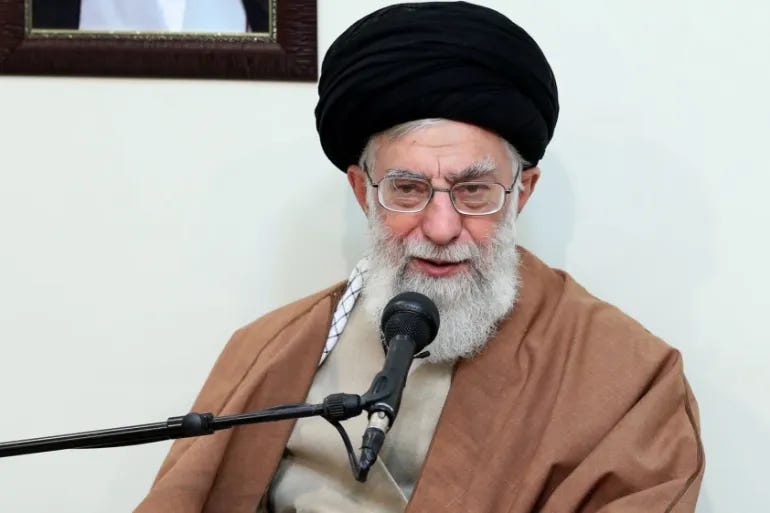
“We talk to protesters; the officials must talk to them, but there is no benefit to talking to rioters. Rioters must be put in their place…”
- Supreme Leader Ali Khamenei
A merchant in Tehran doesn’t need a pundit to tell him the regime is in trouble.
He knows it the moment he tries to restock his shelves.
In late December, shopkeepers in central Tehran shut their doors as the rial slid, and street protests followed—met by riot police and tear gas. That’s what collapse looks like when it reaches the ground: not an argument about ideology, but a shop owner realizing the cash in his drawer won’t replace what he sold yesterday.
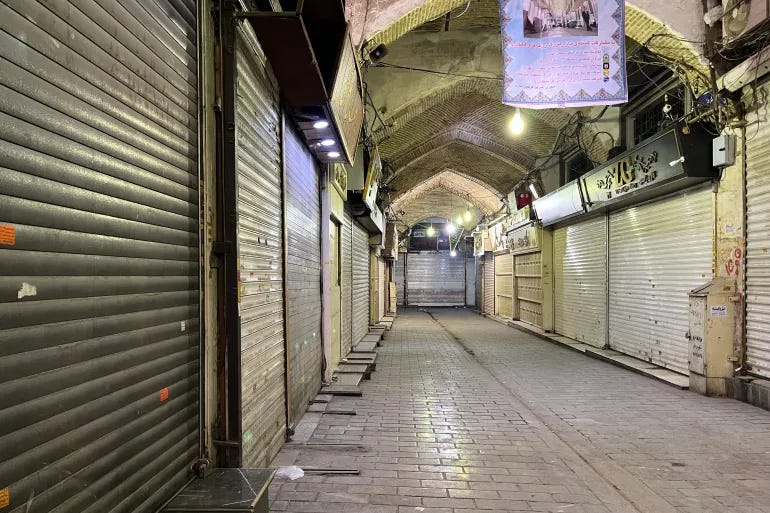
When a currency starts moving like a penny stock—when wholesalers won’t hold a quote, when importers say “call tomorrow,” when a paycheck arrives lighter each week—you’re no longer arguing about politics. You’re arguing about whether money still works.
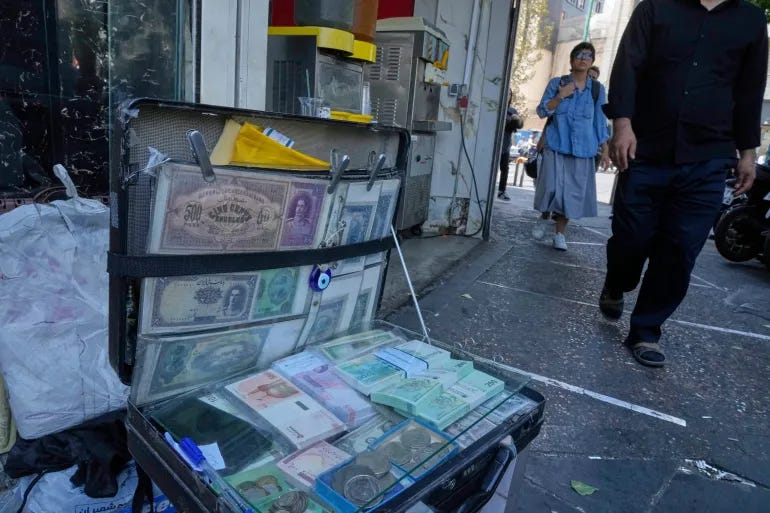
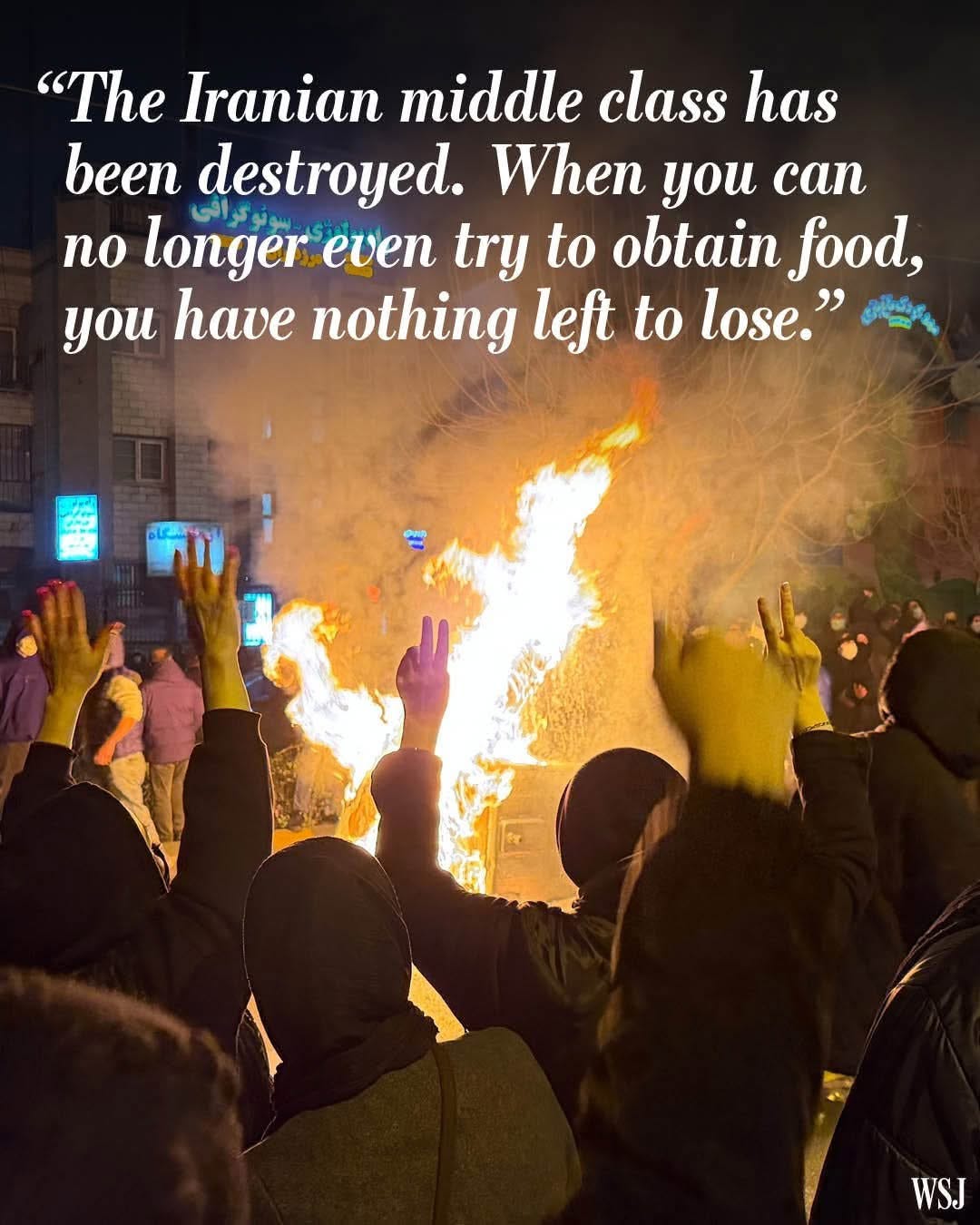
And when money stops working, regimes often answer protestors with force. Rights groups say the crackdown since late December has killed thousands and led to tens of thousands of arrests—numbers that are hard to verify in real time amid blackouts and fear, but directionally clear in their meaning: the state is trying to reassert monetary credibility with batons and bullets.
For twenty years, the American foreign-policy establishment has been trapped in the “2003 model”: if the Middle East changes, it must be because we invaded it. Most Americans—especially in the Rust Belt—know how that story ends.
But Iran’s regime isn’t being cornered by an army.
It’s being cornered by arithmetic.
Ray Dalio’s debt-crisis framework has a name for this pattern: an ugly deleveraging—when a state tries to solve solvency with liquidity until the currency breaks.
The most dangerous weapon in the Middle East right now isn’t a missile.
It’s the bank ledger.
How a bank failure sparks a fire
The Wall Street Journal reported Ayandeh—tied to regime-connected elites—collapsed under nearly $5 billion in bad loans, with the state folding it into a state-run lender and leaning on money creation to contain the hole.
In a normal system, a bank like that goes down. Equity gets wiped. Creditors take pain. The system resets.
In an oligarchy, you don’t let your friends take the loss.
And even when officials insist “shareholders will bear it,” people price the lived reality: big holes don’t disappear. They get socialized—usually through the currency. That’s when confidence doesn’t wobble. It breaks. Because a bailout for insiders tells everyone else one thing:
the currency is the release valve.
The Ayandeh blowup didn’t create Iran’s anger—it focused it, by turning abstract corruption into a daily currency crisis ordinary people could feel at the register and the dinner table.
Iran isn’t dealing with a normal inflation cycle. It’s dealing with purchasing-power collapse—the kind where savings don’t “decline,” they evaporate.
Here’s the key datapoint, and it matters because it’s the mechanism that turns a financial crisis into a legitimacy crisis:
The Journal reported the rial lost 84% of its value against the dollar in 2025, while food prices rose at a 72% annual rate.
Reuters, using a different framing and exchange-rate reference, described the rial as losing nearly half its value in 2025.
That discrepancy isn’t a contradiction so much as a feature of a currency crisis: multiple rates, multiple “truths,” one shared reality—ordinary people can’t plan, save, or restock.
That’s why Dalio calls it “ugly.” The government thinks it’s solving liquidity. It’s actually detonating trust. Printing becomes an implicit tax—a transfer from wage earners and savers to whoever touches the newly created money first.
And once households internalize that, they do the rational thing: they run—not always out of Iran, but out of the rial.
One of the most revealing details wasn’t the protest itself. It was the attempted framing. State outlets acknowledged unrest while insisting shopkeepers were only upset about economic conditions—no quarrel with the system. That’s not reassurance. That’s triage.
Because currency crises don’t stay in the economy lane. When money stops working, every transaction becomes political. Every price tag becomes an argument about who gets protected—and who gets diluted.
The bazaar signal
Not a kingmaker anymore—still a warning flare
It’s tempting to write the bazaar like it’s still 1979: the backbone of the system, the deciding vote, the final domino. That’s outdated.
Over the past two decades, the bazaar’s economic power and political sway have been steadily eroded—squeezed by chronic inflation, sanctions management, and state favoritism toward IRGC-linked conglomerates and bonyads that expanded across banking, infrastructure, and petrochemicals.
That’s exactly why today’s bazaar unrest matters.
When even this historically “loyal sector” won’t stay quiet—when leaders publicly try to separate “legitimate” bazaar grievances from “rioters,” and the separation fails in practice—you’re seeing the limits of narrative control at the moment the money is failing.
The bazaar isn’t the regime’s old engine. It’s the regime’s dashboard light: a constituency the system used to manage is now flashing red.
The hard-currency reality
Iran’s last reliable hard-currency engine is oil. But that engine runs through geography.
Reuters’ infrastructure overview notes Iran exports about 90% of its crude via Kharg Island. In plain English: the hard-currency pipeline is concentrated. One meaningful disruption doesn’t “hurt exports.” It becomes a national budget problem.
And the dependence is not subtle: Iran’s shipped crude is largely a one-buyer business—Reuters reports China purchased over 80% of Iran’s shipped crude in 2025, averaging about 1.38 million barrels per day. That’s the regime’s hard-currency paycheck, routed through one chokepoint and one main customer.
You don’t need Hollywood “shock and awe” to understand a chokepoint.
You just need to understand cash flow mechanics.
Why it’s the 1950s—not 2003—and why 1979 is the warning label
The best analog isn’t Iraq in 2003. It’s the mid-century handoff—the moment when European umbrellas weakened and Washington found itself managing the spillover. The clean marker is Suez in 1956: Britain and France tried to act like the old order still held; the crisis ended with U.S. pressure forcing retreat, and the aftermath left a vacuum question hanging over the region—who maintains order when the old powers can’t? That logic hardened quickly into doctrine and alliance architecture, because the U.S. concluded that if it didn’t inherit the problem, the Soviets (or local radicals) would.
That’s the rhyme if Iran breaks: vacuums form, neighbors move, and outsiders get pulled into containment whether they “want to own it” or not. Vacuum periods don’t wait for careful plans. They trigger coups, cascades, and opportunism—regimes fall, borders become less meaningful than networks, and markets reprice risk in real time. In that environment, the relevant question isn’t “Do we invade?” It’s “How do we prevent the spillover from becoming the new baseline?”
Iran adds the warning label. 1953 isn’t a history seminar inside Iran; it’s a propaganda tool—proof, in the regime’s telling, that any opposition is foreign-made. And 1979 is the modern consequence: a revolutionary state that turns anti-foreign identity into governing legitimacy, meaning visible outside fingerprints can revive a failing regime by handing it nationalism on a platter. The constraint is ugly but clear: pressure can work—but the narrative can boomerang if you make it too easy for Tehran to say, “See? It’s not our corruption. It’s them.”
Iran at an inflection point
Rust Belt Reader rule: study the past, measure the present, imagine the future—apply scenarios with signals.
Muddle-through authoritarianism looks like tighter capital controls, rationing, selective relief, harsher policing.
Signals: more controls + more force + bigger “support” payments that still lag prices.
Elite fracture happens when insiders stop trusting insiders—when procurement breaks and patronage stops clearing.
Signals: scapegoat campaigns, “anti-corruption” theater, arrests of financial actors, abrupt policy whiplash.
Hard-currency seizure is the cliff. If the oil pipeline gets disrupted—by labor, accident, conflict risk, or logistics—this stops being a “bad economy” story and becomes a budget stop.
Signals: sustained export disruption and emergency measures that look like crisis management, not commerce.
What the U.S. should do—now
Here’s the recommendation, stated plainly:
Finish the job. Not with occupation. Not with nation-building. With regime destruction—breaking the Islamic Republic’s ability to reassert control, finance repression, and sprint for strategic weapons.
If the regime is truly wobbling, half-measures are the most expensive option. They produce the worst combination: theocracy survives, purges harder, and returns more dangerous—while the U.S. and its allies look like they flinched.
So the strategy should be disciplined:
Use decisive, non-occupational force to disable the regime’s coercive and strategic machinery—air power where it matters, cyber where it bites, covert pressure where it fragments decision nodes.
Prioritize chokepoints over symbolism: hit the systems that fund and protect repression (command-and-control, internal security enablement, high-leverage infrastructure), not the targets that merely generate headlines.
Make the regime choose between guns and bread by raising the cost of coercion until payroll stress becomes political fracture.
Then pair that pressure with the stabilizing logic history demands:
Don’t attempt to run Iran. Avoid occupation and “build-a-state” fantasies.
Keep fingerprints light. Support information access, humanitarian channels, and transition-ready alternatives without branding the opposition as foreign-owned.
Prepare for the vacuum. A vacuum is dangerous. A nuclear-armed, solvent theocracy is existential. We can contain a mess. We cannot contain a breakout funded by a recovered economy.
Act forcefully to end the threat—but don’t try to own the aftermath.
The bottom line
Coercion has a payroll
A state can survive being unpopular. It can survive being mocked. Sometimes it can even survive military embarrassment.
What it can’t survive is a currency no one trusts—because coercion has a payroll.
You have to pay the police. Pay the army. Pay the militias. Pay the bureaucracy. If you’re paying them in money that can’t hold value long enough to buy essentials, loyalty doesn’t vanish for philosophical reasons.
It vanishes for practical ones.
We aren’t watching “the next Iraq.”
We are watching the liquidation phase of a political system whose check finally bounced.
What to watch next
Currency velocity: are rials spent instantly, with savings fleeing into dollars/gold immediately?
Bazaar alignment: do closures and merchant action stay “economic,” or turn explicitly political?
Security payroll stress: late wages, defections, or wages that can’t buy essentials.
Hard-currency flow: any sustained disruption to exports—especially through Kharg—becomes a fiscal event.
Narrative control: does Tehran successfully blame foreigners—or do people keep eyes on insider bailouts and broken money?
Repression spiral: rising death tolls, mass arrests, and public talk of capital charges/executions—because that’s the regime’s “solution” when the currency can’t do the job anymore.
The printing press can run hot for a long time. But once a population decides the money is a lie, it is just a matter of time.
broken money → street panic → coercion → legitimacy collapse
Sources
Al Jazeera (Dec. 29, 2025): protests and shop closures tied to the currency slide.
Al Jazeera Opinion (Jan. 10, 2026): why bazaar merchants are protesting and how the bazaar’s power has shifted over two decades.
Wall Street Journal (Jan. 13, 2026): Ayandeh Bank collapse, elite ties, bailout dynamics, and the economic-political transmission chain.
Reuters (Jan. 13, 2026): China buying over 80% of Iran’s shipped crude (~1.38 mbpd in 2025).

If this was useful, subscribe to get the next piece—How ugly deleveragings end (and what the signals look like before the break). And if you know someone still stuck in the “2003 model,” share this with them.
Wow! Incredibly awful for the poor (literally) people of Iran. Hopefully, Trump will refrain from meddling.