
Liberation Day
The afternoon a show of sovereign strength revealed the limit of sovereign strength.

Editor’s Note: Money has been hollowed before — Rome thinned the silver out of its coins; Renaissance Florence watched a market discount the promises of a state it no longer trusted. This essay is not a claim that the U.S.A. is Rome, or Florence. The economic and political base in each case is often unrecognizably different. What recurs is not the precise mechanics, but the people who run it, and the incentive they cannot escape. This is one episode of that old pattern, in a new base, read off a single afternoon’s data tape.
By Luca Pacioli | Pittsburgh, PA
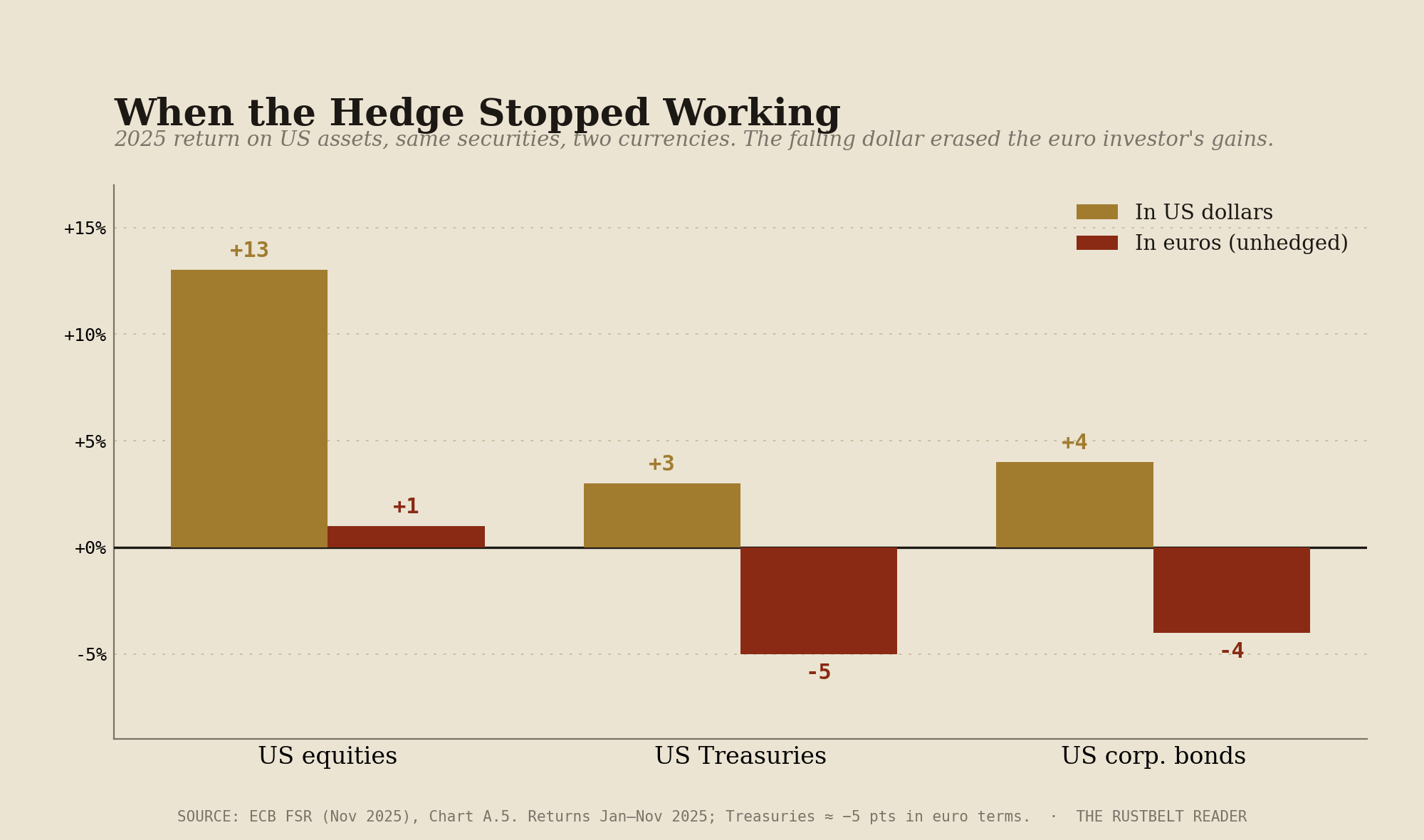
There is a reflex every trader learns before they learn anything else. When the world catches fire, money runs to the dollar. It ran there in 2008, when the crisis began in American mortgages and the dollar rose anyway. It ran there in March 2020, when a virus shut the world down and the dollar spiked so hard the Federal Reserve had to open swap lines to relieve the squeeze. The pattern was so reliable it had a name — the dollar smile — and it was so trusted that investors the world over held American stocks without hedging the currency, confident that if equities fell, the dollar would rise to cushion the blow. The safe haven was treated as a law of nature. You did not insure against it any more than you insured against the sun coming up.
On April 2, 2025 — the day the administration branded “Liberation Day” — the law bent.
The name was an assertion of strength. The tariffs it announced — a ten percent baseline on imports from most of the world, with steeper “reciprocal” rates layered on top — were framed as an act of economic sovereignty: America freeing itself from a trading order it judged unfair, reclaiming leverage, putting itself first. The promise, in concept, was power. The market delivered something closer to its opposite.
Equities cratered; the S&P 500 would lose roughly eleven percent in six trading days. The VIX, the market’s fear gauge, spiked to a level it had reached only twice before — in the 2008 crisis and the 2020 shutdown. This was a risk-off event of the first order, and the reflex should have fired. Money should have run to the dollar and to Treasuries, lifting the currency and pushing yields down.
It did the opposite. The dollar fell — the dollar index dropping more than four percent over the following sessions to a three-year low. And long-term Treasury yields rose, the ten-year climbing from under four percent to a four-and-a-half percent intraday spike within a week, the thirty-year pushing past five. The two assets the entire architecture of global finance treats as the floor — the dollar and the Treasury — fell through that floor together. A day named for liberation produced, for a stretch of weeks, a small loss of the one thing that makes a country financially sovereign: the world’s automatic willingness to hold its paper when it is afraid.
What the textbook expected
To see why this mattered, you have to see what it violated.
In an ordinary risk-off episode, the dollar and Treasury yields move in a specific, reassuring way. Frightened money buys Treasuries, pushing their prices up and their yields down. That same money buys the dollars it needs to buy those Treasuries, pushing the currency up. So the dollar rises while yields fall, and the relationship between the currency and the yield is positive. This had been especially tight through 2024. It was the mechanical signature of the dollar’s reserve status: in a storm, the world pays the United States for shelter, and it pays by accepting lower yields and bidding up the currency.
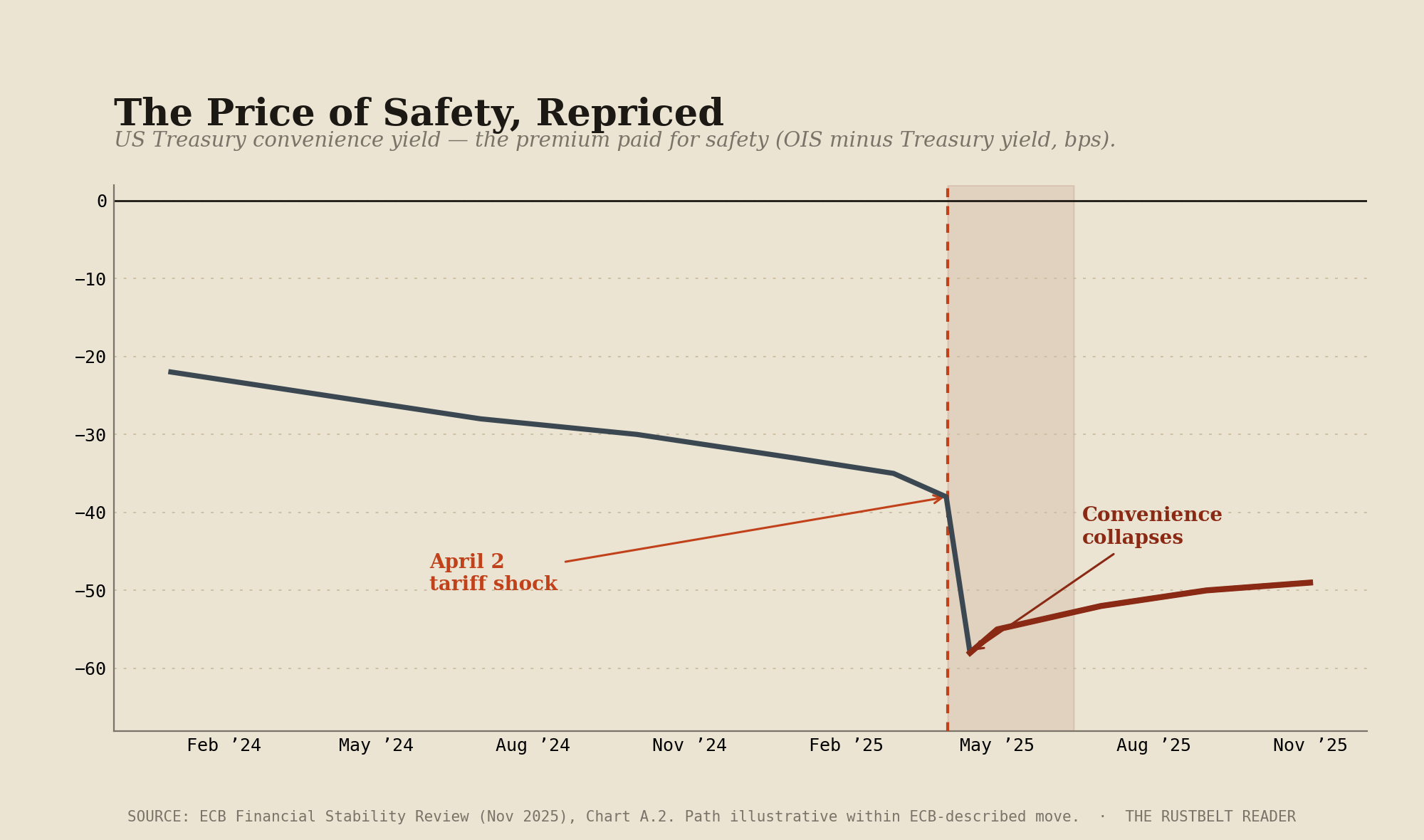
That payment is what economists call the convenience yield — the premium the world hands America for the safety and liquidity of its assets. It is not a moral tribute and it is not a verdict on American virtue. It is a price the world pays for a service it finds useful, and like any price, it can be renegotiated. The dollar smile and the convenience yield are two faces of one arrangement: the world’s standing willingness to hold American claims in a crisis, built up over decades until it became invisible, taken for granted by holder and issuer alike.
A willingness that invisible is rarely examined. And an arrangement that is never examined is exactly the kind that can be reconsidered, suddenly, when something makes the world look closely at what it had stopped questioning.
What the day actually was
Here is the discipline this episode demands, because it invites two opposite errors and the honest reading has to refuse both.
The first error is to wave it away. There is a real, unglamorous explanation for part of what happened: when a country imposes tariffs and its partners retaliate, standard open-economy mechanics predict its currency weakens — no loss of faith required, just trade and capital flows adjusting. By that reading, the dollar’s fall was an ordinary response to a trade war, and the safe-haven framing is overwrought. This is not a weak argument, and it explains a meaningful share of the currency move.
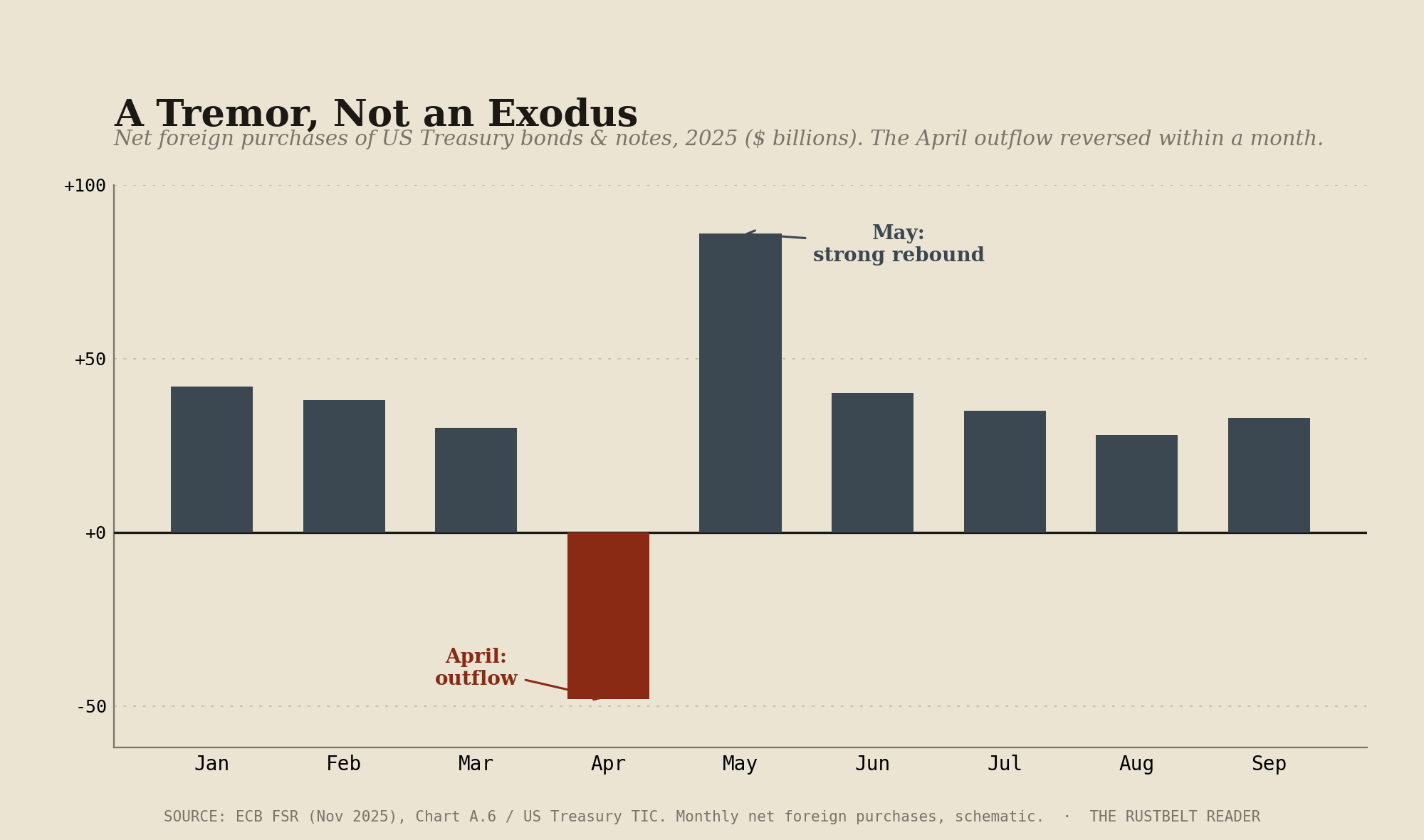
The second error is to call it a collapse. It was not. By the second half of the year the relationship had normalized; the dollar found a footing, the Treasury market kept functioning, and the convenience yield measured across the full year showed no dramatic break against 2024. No spiral took hold. This was not the earthquake. It was a tremor.
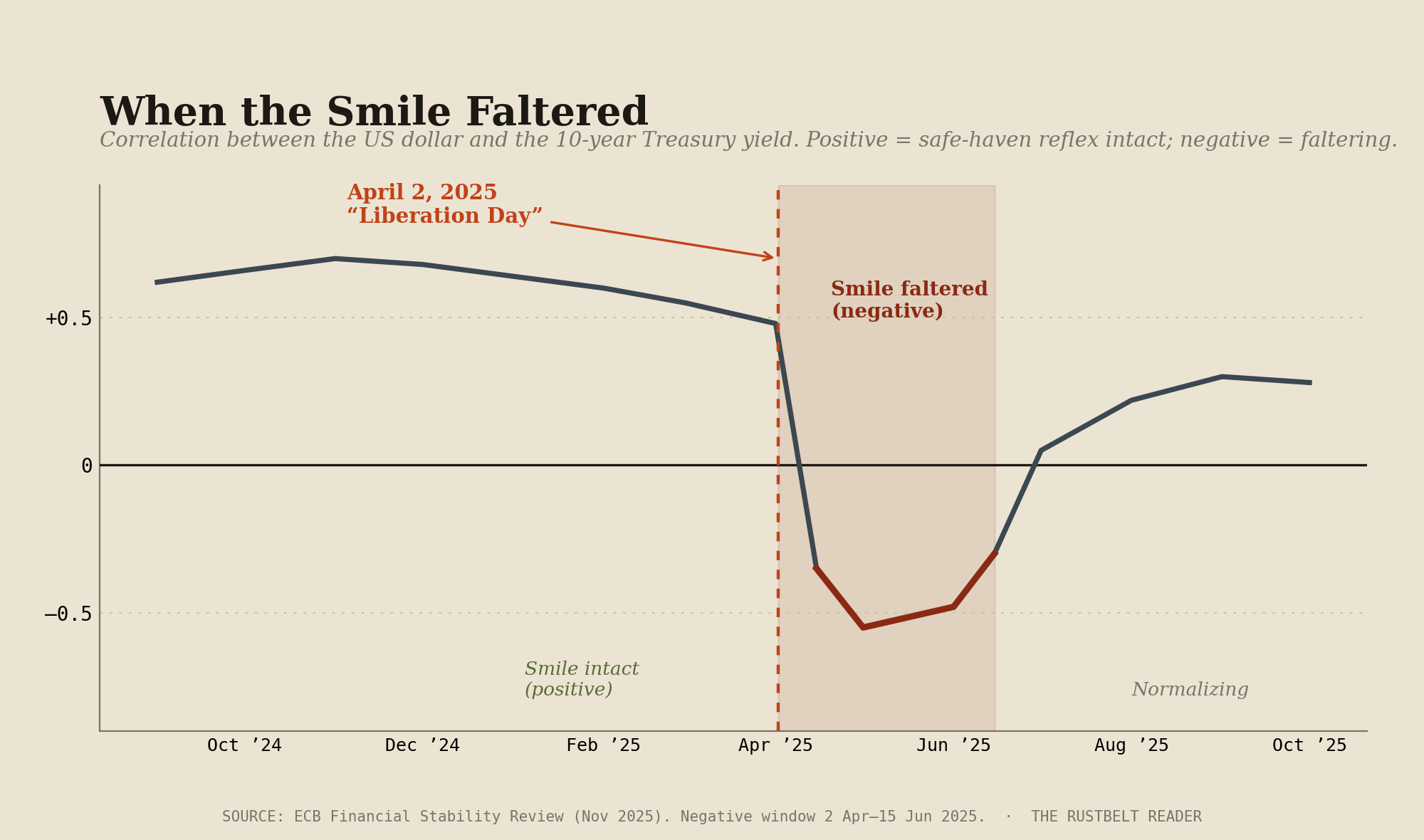
But notice where the two innocent explanations stop. The currency move has a tidy mechanical cause. The yield move does not. Long-term Treasury yields spiking during a flight-to-safety episode — the safe asset selling off in the middle of the fear it is supposed to absorb — is not explained by retaliation mechanics. The European Central Bank, dissecting the episode months later, documented the tell: the normally positive correlation between the dollar and Treasury yields turned negative after April 2 and stayed negative into mid-June, roughly ten weeks. The relationship that had defined the safe-haven trade simply ran backward. The International Monetary Fund traced part of the yield spike to forced selling — leveraged funds unwinding Treasury positions into a falling market, dealers reaching the limits of what they could absorb. That is the same fragile plumbing this newsletter has examined before, engaged here on the reserve asset itself. But forced selling explains the mechanism, not the motive: it tells you how the move accelerated once it began, not why investors were willing to step away from the world’s benchmark safe asset in the first place. Deleveraging is the accelerant. The question is what lit it.
So the honest account is narrow and specific. For about ten weeks, in a way you could read on a screen, a piece of the world stopped automatically paying America for shelter and began, at the margin, to ask what the shelter was worth. The currency wobble had an innocent explanation. The safe asset behaving like a risk asset did not.
What it could not command
This is what makes the day worth an essay, and it is why the name is the story.
Liberation Day was an exercise of sovereign will. A government can set its tariffs; that power is real and it was used. But the thing the policy briefly disturbed was not within any government’s command. The dollar’s safe-haven status is not a sovereign possession. It is an inheritance — held by everyone else, by the central banks and pension funds and corporations and traders who choose, each time, whether to keep treating American paper as the floor.
And “trust” here is not a mood; it rests on specific institutions, which is precisely what the episode put in question. Three doubts surfaced at once. The tariffs themselves raised the predictability of trade and economic policy — a baseline-plus-reciprocal regime announced by decree signaled a policymaking process investors could no longer easily forecast. The deficit path raised the question of fiscal sustainability — who absorbs relentless issuance, and at what yield. And, most pointedly, the period’s open pressure on the Federal Reserve raised the question of central-bank independence: public speculation over whether the administration might seek to remove the Fed chair fed directly into the asset sell-off. The world was not reassessing some abstract American virtue. It was repricing three concrete institutions — the executive’s trade policy, the fiscal accounts, and the central bank — whose credibility together is what the convenience yield pays for. A state can decree what it charges in tariffs. It cannot decree that the world keep trusting those institutions. Liberation Day was the moment that distinction printed itself on a screen.
And this is where the day connects to a much older pattern — not by analogy, but by recurrence. The constant across the centuries is not the mechanism, which changes completely with the economic base. It is the incentive faced by whoever holds the unit of account. A custodian of the money always answers to a present constituency whose loyalty must be secured now, and can secure it by drawing down a credibility that will not be missed until later — on someone else’s watch. The substance differs entirely. Rome’s emperors bought the legions by thinning the coin, because an emperor who failed to pay his soldiers was replaced by one who would. Florence bought its elite by making their forced loans tradable — turning public debt into an asset class its own ruling class could hold and sell. A modern democracy buys its electorate by promising benefits now and deferring the fiscal reckoning to a generation not yet voting. The legion, the elite, and the electorate are different paymasters — that is the base changing across two thousand years. Buying a present constituency with future credibility is the human constant. It is the one thing that recurs.
There is a trap folded inside this. The deeper a system’s inherited trust, the more it can borrow against — so the most credible powers accumulate the most deferred cost, because their trust is the deepest well to draw down. The Augustan denarius was trusted enough to debase for two centuries before the belief finally broke. The dollar is the deepest reservoir of monetary trust in history. That is not a guarantee of safety. It is a measure of how long the reckoning can be deferred.
What it costs, and why it is not yet fate
The convenience yield is not a curiosity of bond math. It is the discount at which the United States finances itself — and cheap financing is what has underwritten American power. A country that can borrow more cheaply than any rival can sustain a security commitment, an investment base, and an institutional reach that its fundamentals alone would not support. This is the argument the historian Niall Ferguson has pressed for years: great powers rarely fall because creditors refuse them one morning. They weaken when the cost of servicing the past begins to crowd out the capacity to secure the future — when debt service competes with defense, with investment, with renewal. The privilege that Liberation Day briefly disturbed is the same privilege that funds the primacy. To discover the dollar’s price is, eventually, to discover the price of everything the cheap dollar paid for.
That is the warning. It is not, however, a prophecy — and the difference is the whole of the honest case.
What this kind of episode is not is unprecedented — and the reason it felt unprecedented is itself the point. An earlier essay in this series argued that the easy decade trained the wrong instincts: a long benign regime teaches investors to treat contingent conditions as permanent laws, because expectations are formed by lived experience, not by history. The dollar smile is that same error at the level of the reserve system — a behavior so reliable for so long that the world stopped seeing it as a behavior at all. The longer historical record only confirms it. Reserve transitions of this kind recur, measurably, as they did for the Dutch, the British, and the Habsburgs; Ray Dalio’s debt-cycle work is the most familiar modern catalogue of the pattern. But you do not need five hundred years of data to distrust the reflex. You need only the last ten. April 2025 is one observation in the long series and a direct instance of the recent one: the pattern showing a flicker of itself on a screen.
But a base rate is a prior, not a sentence, and here the caution that perhaps the historian Charles Maier would insist on does the essential work. That long record is a history of choices, not the operation of a law. Each transition in it was politically contingent — settled by what leaders and societies decided to do, not by a curve bending on its own. And the strongest evidence that the determinism is not binding is the episode itself: Liberation Day passed. The correlation normalized in ten weeks. The trust was questioned and, for now, restored. A pattern that recurs is not a fate that is fixed. What recurs is the temptation. What stays open is the response.
What to watch
So what did Liberation Day actually demonstrate? Not that the dollar is finished. Reserve currencies do not die in an afternoon, and the dollar’s embedding in the world’s financial plumbing is deeper than any historical analog, which buys it enormous resilience and a very long deferral. What the day demonstrated is narrower and more useful: the safe-haven reflex is no longer automatic. The thing the system treats as a constant revealed itself, for ten weeks, to be a behavior — a standing choice the world makes, and choices can change.
That reframes the dollar’s privilege from a law into a variable, and a variable is something you can watch. The gauge is the one the ECB used to diagnose the episode: the correlation between the dollar and Treasury yields. When it is positive, the world is still paying for shelter without thinking about it. When it goes negative during a shock that originates in Washington — as it did in April — the reflex is faltering, and the dollar’s price is being discovered rather than assumed. The decisive question for the years ahead is not whether the dollar collapses. It is whether that inversion was a single tremor or the first of a recurring series — whether the next American-made shock prints the same negative correlation, and then the one after that.
It helps to hold two clocks at once. There is a slow one and a fast one, and they are not in tension. The slow clock is the one an earlier essay called the glacial melt — the dollar’s share of global reserves drifting down by roughly half a point a year for a quarter-century, a trend driven not by any single event but by hundreds of reserve managers diversifying at the margin. That erosion is structural, gradual, and nearly invisible quarter to quarter. The fast clock is the trust event — April 2025, ten weeks, printed on a screen and then gone. The fast clock does not replace the slow one; it punctuates it. Most of the time the glacier moves and no one hears it. Occasionally the ice cracks loudly enough to register, and a correlation inverts for a season. The danger is not either clock alone. It is the possibility that the fast events begin to cluster — that the cracks come closer together — and in doing so accelerate the melt that was always underway.
Rome did not fall because it ran out of silver. It fell, slowly and over centuries, because it ran out of credibility about silver — and no decree could legislate that credibility back once the population had learned to check. The lesson is not that America is on that path; the base could hardly be more different, and a single ten-week tremor is not the third century. The lesson is narrower: the part of the system no one can command is the part that matters most, and you cannot see it weaken in advance — you can only watch, after the fact, for the moments it flickers. Liberation Day was one of those flickers. The policy was a sovereign act, fully within the government’s power. The faltering it produced was not within anyone’s power, and that is precisely why it is the thing worth watching.
The smile, it turns out, is not a feature of the dollar’s face. It is a decision the world makes, every time, about whether to keep paying for shelter. For most of a century the decision was automatic. On the day named for liberation, for the first time in a long time, it was not.
Excellent!